

Products


Vanadium-based SCR Catalyst
Vanadium-based catalyst is an important catalyst in the field of diesel engine exhaust treatment. It is mainly composed of vanadium pentoxide (V2O5) as an active ingredient, and is often supplemented with other metal oxides (such as tungsten trioxide WO3, titanium dioxide TiO2, etc.) as additives and carriers. The common appearance of the catalyst is honeycomb, flat, and corrugated.
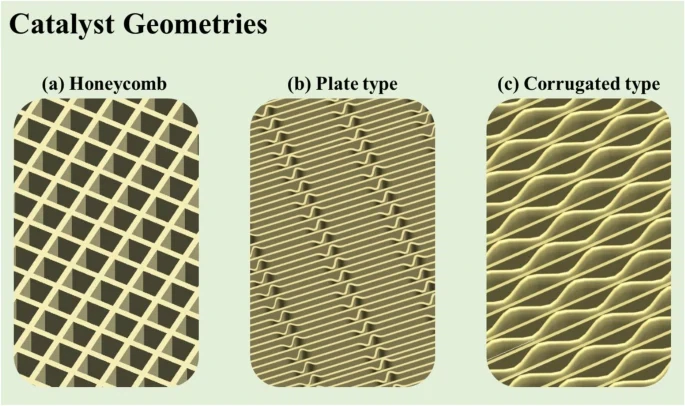
The core of SCR vanadium-based catalyst is vanadium pentoxide (V2O5), which is the main active component in the catalyst. The surface of V2O5 is acidic, and it is easy to capture alkaline ammonia (NH3) on the catalyst surface for reaction. Its specific oxidation advantage is conducive to converting ammonia and NOx (nitrogen oxides) into nitrogen (N2) and water (H2O), which is particularly suitable for oxygen-rich environments. In addition, the catalyst uses honeycomb ceramic materials as carriers and tungsten trioxide (WO3) as additives.
The working principle of SCR vanadium-based catalyst is based on selective catalytic reduction technology. Within a certain exhaust temperature range (usually 300~400℃), urea aqueous solution (or other reducing agent) is sprayed into the exhaust gas and decomposed to produce ammonia (NH3). Subsequently, ammonia reacts chemically with NOx in the exhaust gas under the action of the catalyst to produce harmless nitrogen (N2) and water (H2O), thereby effectively reducing the emission of NOx in the exhaust gas.
It mainly includes the following steps:
Adsorption stage: First, ammonia (NH3) is adsorbed on the active sites of the catalyst as a reducing agent. These active sites are usually Lewis acid centers and Brønsted acid centers formed by vanadium oxides.
Reaction stage: Subsequently, nitrogen oxide (NOx) molecules adsorbed on the catalyst surface interact with ammonia molecules. Under the action of the catalyst, NOx is reduced to nitrogen (N2) and ammonia is oxidized. This process is usually accompanied by the conversion of vanadium oxide between oxidized and reduced states.
Desorption stage: Finally, the nitrogen formed is desorbed from the catalyst surface and released into the flue gas, while the generated water remains on the catalyst surface or leaves in the form of water vapor.
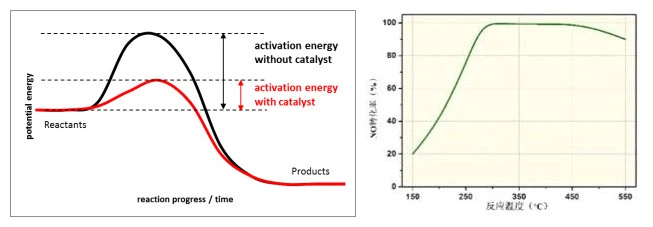
The high efficiency and selectivity of vanadium-based catalysts are attributed to the special electronic structure and catalytic activity of vanadium oxides. The catalyst is designed to optimize the distribution and energy levels of these active sites to promote the SCR reaction while suppressing the occurrence of side reactions. The operating temperature range of vanadium-based catalysts is generally between 310 and 430 degrees Celsius, which is a medium-high temperature catalyst. This corresponds to the flue gas temperature at the outlet of the boiler economizer, allowing the SCR denitrification reactor to be directly installed in this area to achieve efficient denitrification.
Performance characteristics:
Traditional V2O5/WO3/TiO2 SCR catalyst, medium-temperature catalyst, sulfur-resistant, V2O5 is toxic, has a high ignition temperature, a narrow temperature window, poor high-temperature resistance, and there is a risk of polluting the environment after scrapping.
Improved vanadium-based SCR: An improved version of the traditional V-based, low toxicity, sulfur-resistant, and high conversion efficiency at medium temperature.
High conversion activity: SCR vanadium-based catalysts show high NOx conversion efficiency under medium temperature conditions (such as 350~450℃), which can reach more than 90%.
Good sulfur resistance: Vanadium-based catalysts have a high tolerance for sulfur and can maintain good catalytic performance in diesel exhaust with a high sulfur content.
Low toxicity: Compared with other types of catalysts, vanadium-based catalysts have lower toxicity and less impact on the environment and human health.
Strong stability: Under appropriate operating conditions, SCR vanadium-based catalysts can maintain stable catalytic performance for a long time.
Application areas:
SCR vanadium-based catalysts are widely used in diesel engine exhaust aftertreatment systems, especially heavy-duty diesel vehicles with high emission standards and non-road mobile machinery. In addition, SCR vanadium-based catalysts have been widely used in thermal power plants, waste incineration plants, nitric acid plants, nitrate plants, steel plants, fertilizer plants and other industries.
FAQ:
Q: What is your sample policy?
Q: What catalysts do you have?
Q: How to choose denitrification catalyst?
Hot Tags: vanadium-based scr catalyst, China vanadium-based scr catalyst manufacturers, suppliers, factory, Ammonia Slip Catalyst, Cu based SCR Catalyst, Diesel Oxidation Catalyst, Fe based SCR Catalyst, Vanadium based SCR Catalyst, emission control catalysts


