

Hey there! As a supplier in the Biogas Sewage Treatment business, I've seen firsthand the importance of an efficient bioreactor in this field. In this blog, I'll share some key points on how to design one.
Understanding the Basics of Biogas Sewage Treatment
Before we dive into bioreactor design, let's quickly go over what biogas sewage treatment is all about. Biogas sewage treatment is a process that uses microorganisms to break down organic matter in sewage. This decomposition produces biogas, which is mainly composed of methane and carbon dioxide. Methane can be used as a renewable energy source, making this process both environmentally friendly and economically viable. You can learn more about Biogas Sewage Treatment.
Key Factors in Bioreactor Design
1. Volume and Shape
The volume of the bioreactor is crucial. It needs to be large enough to handle the amount of sewage you're planning to treat. However, it shouldn't be too big either, as that would increase construction and operating costs. A common way to determine the volume is by considering the hydraulic retention time (HRT), which is the average time that sewage stays in the bioreactor.
The shape of the bioreactor also matters. Cylindrical bioreactors are quite popular because they have a good surface - to - volume ratio. This allows for better mixing and heat transfer, which are important for the growth of microorganisms.
2. Mixing System
A proper mixing system is essential for an efficient bioreactor. Microorganisms need to be evenly distributed in the sewage to ensure that they can break down the organic matter effectively. There are different types of mixing systems, such as mechanical stirrers and gas sparging.
Mechanical stirrers use blades or impellers to mix the sewage. They can provide strong and consistent mixing, but they also require a significant amount of energy. Gas sparging, on the other hand, involves injecting gas (usually biogas) into the bottom of the bioreactor. This creates bubbles that rise and cause the sewage to mix. Gas sparging is less energy - intensive but may not provide as thorough mixing as mechanical stirrers in some cases.
3. Temperature Control
Microorganisms are sensitive to temperature. Most of the bacteria involved in biogas production work best in a temperature range of 30 - 35°C (mesophilic conditions) or 50 - 55°C (thermophilic conditions). Therefore, it's important to have a temperature control system in the bioreactor.
This can be achieved through insulation to reduce heat loss and the use of heating or cooling devices. For example, a heat exchanger can be installed to transfer heat from the biogas or other waste heat sources to the sewage in the bioreactor.
4. Inlet and Outlet Design
The design of the inlet and outlet of the bioreactor is also important. The inlet should be designed to distribute the sewage evenly across the cross - section of the bioreactor. This helps to prevent short - circuiting, where sewage flows directly from the inlet to the outlet without being properly treated.

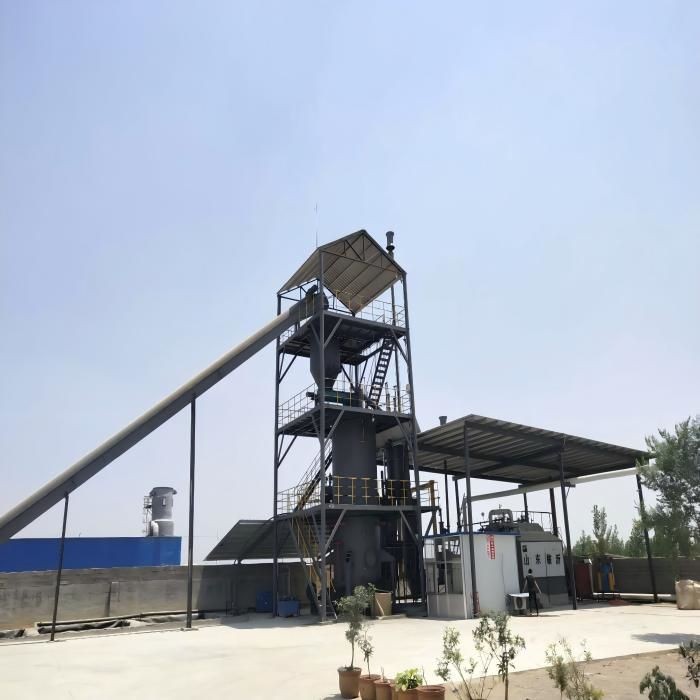
The outlet should be designed to separate the treated sewage from the biogas and any solid residues. A good outlet design can ensure that the biogas is efficiently collected and the treated sewage meets the required quality standards.
Ancillary Equipment
In addition to the main bioreactor, there are also some ancillary equipment that can enhance the efficiency of the biogas sewage treatment process. You can check out Ancillary Equipment for Biomass Gasification for more details.
1. Gas Storage and Conditioning
Once the biogas is produced, it needs to be stored properly. Gas storage tanks are used for this purpose. These tanks should be designed to withstand the pressure of the biogas and prevent any leakage.
Biogas also needs to be conditioned before it can be used as an energy source. This involves removing impurities such as hydrogen sulfide, which can corrode equipment and cause environmental problems.
2. Solids Separation
During the biogas sewage treatment process, there will be some solid residues. These solids need to be separated from the treated sewage. Equipment such as sedimentation tanks, filters, or centrifuges can be used for this purpose.
Monitoring and Control
To ensure the long - term efficiency of the bioreactor, it's important to have a monitoring and control system. This system can measure various parameters such as temperature, pH, gas production rate, and the concentration of organic matter in the sewage.
Based on these measurements, adjustments can be made to the operating conditions of the bioreactor. For example, if the temperature is too low, the heating system can be adjusted to increase it. If the pH is not within the optimal range for the microorganisms, chemicals can be added to adjust it.
Considerations for Different Scales of Operation
The design of the bioreactor also depends on the scale of operation. For small - scale applications, such as in rural areas or small communities, a simpler and more cost - effective design may be preferred. These bioreactors may have a smaller volume and use less complex mixing and control systems.
On the other hand, large - scale bioreactors for industrial or municipal sewage treatment need to be more robust and efficient. They may require more advanced technology and equipment to handle the large volume of sewage and ensure high - quality treatment.
Conclusion
Designing an efficient bioreactor for biogas sewage treatment is a complex but rewarding task. By considering factors such as volume, shape, mixing system, temperature control, inlet and outlet design, and using appropriate ancillary equipment, you can create a bioreactor that effectively treats sewage and produces valuable biogas.
If you're interested in our biogas sewage treatment solutions, whether it's for a small - scale or large - scale project, we'd love to have a chat with you. Contact us to start a procurement discussion and find the best bioreactor design for your needs.
References
- Smith, J. (2018). Biogas Production from Sewage: Principles and Practices. Green Energy Press.
- Johnson, A. (2020). Advanced Bioreactor Design for Wastewater Treatment. Environmental Engineering Journal.
- Brown, C. (2019). Temperature Effects on Microbial Activity in Biogas Reactors. Microbial Ecology Research.


